
Welcome to the website of the Advayavada Buddhism Information Center, the mouthpiece of the Advayavada Foundation. If necessary, increase your font size for easy reading.
Advayavada Buddhism is a secular, non-dual and life-affirming philosophy and way of life derived from Nagarjuna's Madhyamaka, or philosophy of the Middle Way. The most important tenet of Advayavada Buddhism is that there is a fourth sign (or mark) of being implicit in the Buddha's teaching, namely that, expressed purely in terms of human perception and experience, reality is sequential and dynamic in the sense of forever advancing for the better; what human beings experience and identify as good, right or beneficial, indeed as progress, is, in fact, that which takes place in the otherwise indifferent direction that overall existence flows in of its own accord.
To understand this important tenet, one should first come to realize most deeply, for instance through meditation on the incontestable non-duality of the world, that not the human manifestation of life (i.e. its ongoing process of re-combination, mutation, concatenate multiplication and disintegration of the expended units, and its vicissitudes and perils, even possible extinction, self-inflicted or not) is the measure of things in space and time, but that it is the whole of infinite interdependent reality itself, which, hardly affected, if at all, by the negligible impact of mankind's doings on the overall scheme of things, will continue to become exactly as it, by definition, must.
It then becomes very clear to us that the Middle Way taught by the Buddha as the correct existential attitude is not meant to in the least deviate from the Dharma of the whole; that the objective of the Middle Way is, in fact, to reconnect and reconcile us with wondrous overall existence; and that the Middle Way in its dynamic Noble Eightfold Path mode must indeed be seen as an ongoing reflexion at the level of our personal lives of wondrous overall existence becoming over time in its manifest direction. Now, as the Eightfold Path takes us forward for the better and better, it follows, inductively if you will, that, in human terms, existence as a whole becomes over time for the better and better as well. Inversely, we experience as good, right or wholesome those events which are in agreement with the overall otherwise indifferent pattern and direction of existence - it is for this reason that they are experienced thus; this fact is, indeed, the fourth sign or mark of being we speak of.
The purpose of Buddhism is then, obviously, not to shun life as many choose to believe, but, on the contrary, to return mankind to the fold of wondrous overall existence and to delight in it. Buddhism must be understood correctly as a 'way of reconciliation' with the whole of existence just right as it is, i.e. as it truly is beyond our commonly limited and biased personal experience of it. The aim of Advayavada Buddhism is to help us understand this main purpose of Buddhism more clearly and to give us individually the necessary tools to become a true part of the whole, here and now.
Below you will find Advayavada Buddhism in a Nutshell and the Advayavada Study Plan ASP. See the detailed Site Map for more information about the contents of our website, and please note that many of the icons, blue dots, logos and illustrations on all pages are also useful hyperlinks. On separate pages there are, among others, an explanation of the fourth sign of being, more than sixty relevant excerpts from well-known mainly Buddhist books, an Interlude for the Western Mind (about the Dutch philosopher Spinoza), and an extensive and very illustrative Questions & Answers section.
We would love to hear from you too.
Advayavada Buddhism Infocenter,
P.O.Box 10502, 1001 EM Amsterdam, The Netherlands.
Phone and fax: +31-20-6269602,
or email info at advayavada.nl


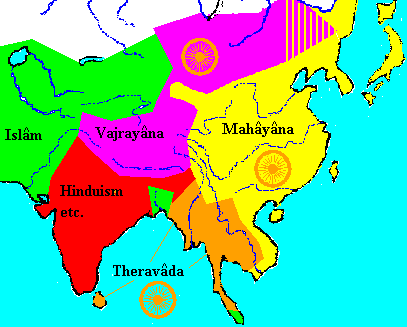
Buddhism is a collective name for the diverse philosophical, esoteric and religious beliefs that are derived from the way of liberation taught, in the 6th century B.C., by the North-Indian prince Siddhartha Gautama, called the Buddha, which means the Awakened or Enlightened One. Advayavada Buddhism, formally established in 1995 as a new, secular branch of Mahayana Buddhism (see map) by the Dutch lay Buddhist author and translator Advayavadananda (John Willemsens, b.1934), is a non-dual and life-affirming philosophy and way of life derived in turn from Nagarjuna's Madhyamaka, or philosophy of the Middle Way. The purpose of Advayavada Buddhism is to help us to become a true part of the whole. Because of its open character and structure, and, above all, its autonomous and non-prescriptive nature, it is difficult to determine how many Buddhists share the views of Advayavada Buddhism worldwide at this time.
According to Advayavada Buddhism, it is indisputable that the Buddha did not believe in Brahman (God, transcendent and immutable Absolute) or in the atman or atta (soul, immortal self) and taught that man suffers because he does not understand and accept that all things in life are instead utterly changeable and transitory; if the Buddha had ever expressed belief in Brahman and the atman or atta, such a fact would have been unequivocally recorded in History. Man is prone to suffering (duhkha, dukkha) quite simply because he wrongly strives after and tries to hold on to things, concepts and situations which he believes to be permanent, but are not.
Man's mistaken view of things is produced by a thirst or craving (called trishna in Sanskrit and tanha in Pali) which is in turn caused by his fundamental ignorance (avidya, avijja) of the true nature of reality. And this thirst or craving can easily take on a more unwholesome form: already as sensuous desire, ill-will, laziness, impatience or distrust will it seriously hinder any efforts to better his circumstances.
His compliance, however, with the five precepts that apply to all followers of the Buddha will allow him to arrest his thirst or craving and to commence removing the root cause of his suffering, i.e. his fundamental ignorance of the true nature of reality. The five fundamental Buddhist precepts are not to kill, not to steal, sexual restraint, not to lie, and abstinence from alcohol and drugs. Man's observance of these precepts in his daily life gives him the moral strength required to embark upon the Buddha's Middle Way that, avoiding first the extremes of self-indulgence and self-mortification, will in due course bring him to the blessed state of Nirvana.
Nirvana is the complete extinction (nirodha) of all suffering (duhkha, dukkha) as a result of our full reconciliation with reality as it truly is. Nirvana and Samsara are not two different realities or two different conditions of reality. Nirvana is to experience the phenomenal world at the level of ultimate truth (paramartha-satya), i.e. truth divested of all our preconceptions, including even those expressed here. Samsara is to experience the same phenomenal world at the level of conventional everyday truth (samvriti-satya). It is as a result of the purification of our perception of the phenomenal world at the level of conventional truth by following the Buddha's Middle Way, that we shall come to understand the significance of ultimate truth and its rewards.
The Middle Way devoid of extremes that we must follow is concretely the Noble Eightfold Path that the Buddha taught in his very first sermon in Sarnath, near Benares. The Noble Eightfold Path, when interpreted dynamically as an autonomous and creative process of progressive insight reflecting in human terms wondrous overall existence becoming over time in its manifest direction, as Advayavada Buddhism does, is that of our very best (samyak, samma) comprehension or insight, followed by our very best resolution or determination, our very best enunciation or definition of our intention, our very best disposition or attitude, our very best implementation or realization, our very best effort or commitment, our very best observation, reflection or evaluation and self-correction, and our very best meditation or concentration towards an increasingly real experience of samadhi, which brings us to a yet better comprehension or insight, and so forth. We thus regain our place in totality advancing over time, in human terms, for the better and better, breaking, as we advance along the Path, the fetters (samyojana) that restrict us to Samsara.
Advayavada Buddhism indeed considers progress (pratipada, patipada) as the fourth sign of being, this next to the impermanence and the selflessness of all things and the ubiquity of suffering in the world, which are the three signs or marks of being traditionally taught in Buddhism. When the Path expounded by the Buddha as the correct existential attitude and way of life is viewed as an ongoing reflexion at the level of our personal lives of wondrous overall existence becoming over time, it follows that human beings experience as good, right or beneficial that which takes place in the otherwise indifferent direction that time-being as a whole flows in of its own accord. The teaching of the Buddha must be seen as a Way of Reconciliation with wondrous existence as a whole just right as it is, i.e. as it truly is beyond our commonly limited and biased personal experience of it. Nirvana is, in Advayavada Buddhism, the ultimate reconciliation with reality becoming achievable by man. Indeed, in certain schools of Buddhism, Nirvana itself is seen as the fourth sign of being or seal of the dharma.
The revelation of Buddhism is in its practice: The Noble Eightfold Path, when interpreted dynamically as an ongoing and autonomous, non-prescriptive, investigative and creative process of progressive insight reflecting in human terms wondrous overall existence advancing over time in its manifest direction, as Advayavada Buddhism does, is (1) that of our very best (samyak, samma) comprehension or insight followed by (2) our very best resolution or determination, (3) our very best enunciation or definition of our intention, (4) our very best disposition or attitude, (5) our very best implementation or realization, (6) our very best effort or commitment, (7) our very best observation, reflection or evaluation and self-correction, and (8) our very best meditation or concentration towards an increasingly real experience of oneness with the universe, which brings us to a yet better comprehension or insight, and so forth. By following the Noble Eightfold Path thus you get in tune with wondrous overall existence advancing over time, sorrow, doubt and remorse immediately start disappearing, and your life at once gathers new impetus.
The Buddha's Middle Way devoid of extremes as understood by us, has no beginning nor end and is very adequately depicted by the Wheel of the Teaching (dharmacakra, dhammacakka). When followed conscientiously, it becomes nothing less than the main karmic factor in one's share in the universal interdependent origination process (madhyamaka-pratityasamutpada).
The Noble Eightfold Path in Advayavada Buddhism is fully personalized: it is firmly based on what we increasingly know about ourselves and our world, and trusting our own feelings and conscience. Adherence to the familiar Five Precepts and a well-considered understanding of the Four Signs of Being and the Four Noble Truths suffice to start off on the Path at any time. Nirvana is, in Advayavada Buddhism, the total extinction of existential suffering as a result of our complete reconciliation with reality as it truly is. The Path is, in other words, the sure road to enlightenment.
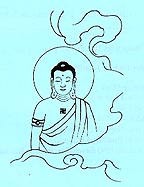
samadhi = total concentration (of the mind, cf. enstasy); total absorption in the object of meditation; transcendence of the relationship between mind and object; merging of subject and object; to contemplate the world without any perception of objects; suspension of judgement; turiyatita; satori; bodhi; rigpa; realization of the sameness of the part and the whole, of the identity of body and mind, of form and emptiness, of samsara and nirvana, of the immediate and the ultimate, of god and nature; mystic oneness; perfect attunement with wondrous overall existence advancing over time in its manifest direction; oceanic feeling; wonder, awe, rapture; essential purity; deep love and compassion; awareness of our common ground and the innocence of sex.
The purpose of the autonomous Advayavada Study Plan ASP is that we study (and debate in a local group, the family circle or with good friends) the meaning and implications of the weekly subject, not as a formal and impersonal intellectual exercise, but in the context of whatever we ourselves are presently doing or are concerned with, or about, such as our health, relationships, work, study, our place in society, etc. Advayavada Buddhism does not tell you what to do or believe, but how to make the very best of our own lives by becoming as wondrous overall existence advancing over time now in its manifest direction.
Week of the current year and subject:
Preliminary subjects:
01, 14, 27 and 40 : The impermanence of all existents (First Sign of Being).
02, 15, 28 and 41 : The selflessness of all existents (Second Sign of Being).
03, 16, 29 and 42 : Existential suffering (Third Sign of Being and First Noble Truth).
04, 17, 30 and 43 : Craving and its elimination (Second and Third Noble Truths).
05, 18, 31 and 44 : Path and Progress (Fourth Noble Truth and Fourth Sign of Being).
The Noble Eightfold Path:
06, 19, 32 and 45 : Our very best comprehension (First Step on the Noble Eightfold Path).
07, 20, 33 and 46 : Our very best resolution (Second Step on the Noble Eightfold Path).
08, 21, 34 and 47 : Our very best enunciation (Third Step on the Noble Eightfold Path).
09, 22, 35 and 48 : Our very best disposition (Fourth Step on the Noble Eightfold Path).
10, 23, 36 and 49 : Our very best implementation (Fifth Step on the Noble Eightfold Path).
11, 24, 37 and 50 : Our very best effort (Sixth Step on the Noble Eightfold Path).
12, 25, 38 and 51 : Our very best observation (Seventh Step on the Noble Eightfold Path).
13, 26, 39 and 52 : Our very best meditation (Eighth Step on the Noble Eightfold Path).
...and so forth!
Tip: Write down the weekly subject in your pocket diary!
[preliminary subject 1] Anicca (Pali) or anitya (Sanskrit) means impermanent, changeable, unstable, transitory. The Buddhist aniccata or anityata doctrine teaches that impermanence or changeability is the most fundamental property of everything existing; it lies at the very heart of the interdependent origination and emptiness of all things (see next week), and growth, progress and liberation would not be possible without it - karma is, in Advayavada Buddhism, this incessant universal process of interdependent origination of all things as it is undergone and experienced by sentient beings, our individual share of it being the everchanging knotlet of biopsychosocial (bps) events in which we are personally embedded.
[preliminary subject 2] Anatta (Pali) or anatman (Sanskrit) means no-self. Anatta (Pali) or anatman (Sanskrit) means no-self. The Buddhist anatta or anatmata doctrine teaches that no soul, spirit or self exists in the person in the sense of a permanent, eternal, integral, and independent substance. In Mahayana Buddhism, the nissvabhava doctrine teaches further that as all things without exception are produced by interdependent origination, they are therefore all empty (shunya) of self-nature (svabhava); svabhava-shunyata (lit. self-nature emptiness) is a central notion in Madhyamaka philosophy. In Advayavada Buddhism, the selflessness of all existents is one of the four signs or marks or basic facts of being, the other three being the impermanence or changeability of everything (see week 40), the ubiquity of existential suffering, and evolution or, in human terms, progress.
[preliminary subject 3] Dukkha (Pali) or duhkha (Sanskrit) means suffering, sorrow; dissatisfaction; frustration; stress; gnawing unease; existential distress, caused a.o. by distrust of life and fear of retribution; it is the first of the four noble truths of Buddhism. In Advayavada Buddhism, dukkha or duhkha does not include emotional grief nor physical pain and is, above all, not seen as a permanent feature of reality: in the context of the four noble truths, it is essentially understood as the existential suffering in the sense of a basic frustration, even suffocation, caused by the unhealthy and socially infectious feeling that reality does not conform to the person's desires and expectations; it is, in Advayavada Buddhism, the third of the four signs or marks or basic facts of being, and the unremitting persistency of human distress, alienation and conflict in the world is seen as being mainly due to the very many everywhere not knowing or not understanding or simply disbelieving the actual, i.e. durational and finite, nature of existence.
[preliminary subject 4] Man is basically prone to existential suffering (dukkha, duhkha) because he wrongly strives after and tries to hold on to things, concepts and situations which he believes to be permanent, but are not. His mistaken view of things is produced by a thirst, craving or clinging (tanha in Pali, trishna in Sanskrit) which is in turn caused by his fundamental ignorance (avijja in Pali, avidya in Sanskrit) or disbelief of the true nature of existence, i.e. its changeability and selflessness or emptiness. This is the second noble truth of Buddhism, and this thirst, craving or clinging can moreover easily take on a more unwholesome form: already as sensuous desire, ill-will, laziness, impatience or distrust will it seriously hinder the individual's efforts to better his or her circumstances, as well as contaminate the efforts of others to improve theirs.
[preliminary subject 5] In Secular Buddhism generally, firmly bearing in mind the impermanence and selflessness of all things, the focus is on the correct interpretation and realization of the historical Buddha's so-called 'four noble truths': 1) that of the ubiquity of existential suffering in the world, 2) that ignorant craving and attachment are the actual and immediate causes of such suffering, 3) that this suffering shall cease altogether when we deal with and overcome its causes, and 4) that the sure way to achieve this is by following the Noble Eightfold Path, which, in Advayavada Buddhism, is understood as an ongoing and fully autonomous, non-prescriptive, investigative and creative process of progressive insight, reflecting in human terms wondrous overall existence becoming over time in its manifest direction.
first uploaded 14 August 1997 -
last modified 16 January 2021.
© 1997-2021. Contents subject to change.

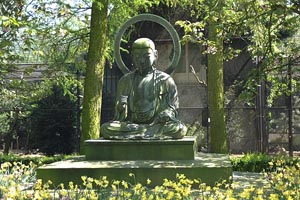
 In Nederland: Gelieve uw vrijwillige bijdrage te storten op rekening NL83ABNA0814472079 t.n.v. de Advayavada Stichting, te Amsterdam. Elk bedrag is welkom. Hartelijk dank!
From abroad: Please instruct your bank to transfer your donation to the Advayavada Stichting, account NL83ABNA0814472079 at the ABN-AMRO Bank, Singel 548, 1017 AZ Amsterdam (BIC: ABNANL2A). All amounts welcome. Thank you very much!
| search engine by freefind |